Overview
The Oslo Cultural Centre occupies a prominent waterfront site in the Bjørvika district, adjacent to the Oslo Opera House and directly facing the Oslofjord. The commission was awarded following an international competition in 2019, and construction completed in early 2024.
The brief asked for a building that would serve as a civic anchor for a neighbourhood in transformation: a place for performance, exhibition, gathering, and education that would be equally accessible to the city's oldest residents and its newest arrivals.
Design
The building is conceived as a threshold. Not a monument, not a landmark — a threshold between the city and the fjord, between the built and the open, between the programmed and the accidental.
The form is a single continuous horizontal volume that steps down toward the water in a series of cascading terraces. Each terrace is simultaneously roof, facade, and public space. The building cannot be read from a single viewpoint — it reveals itself differently from the street, from the water, and from above.
The primary structural move is a series of long-span concrete frames that allow the interior to be entirely column-free. The largest space — a 1,200-seat performance hall — is suspended within the building volume, isolated acoustically from the surrounding structure by a system of spring mounts. From outside, its presence is invisible. From inside, it is total.
Public Space
Forty percent of the building's area is publicly accessible without a ticket. The terraces, the foyer, the library, and the rooftop are open from six in the morning until midnight, every day of the year. This was a condition of the competition brief and a commitment that shaped every aspect of the design.
The foyer is not a lobby. It is a covered public square — a space with the scale and the ambition of the city outside, brought under a single roof. On a cold Oslo evening in January, it is the warmest place in the neighbourhood.
Materials
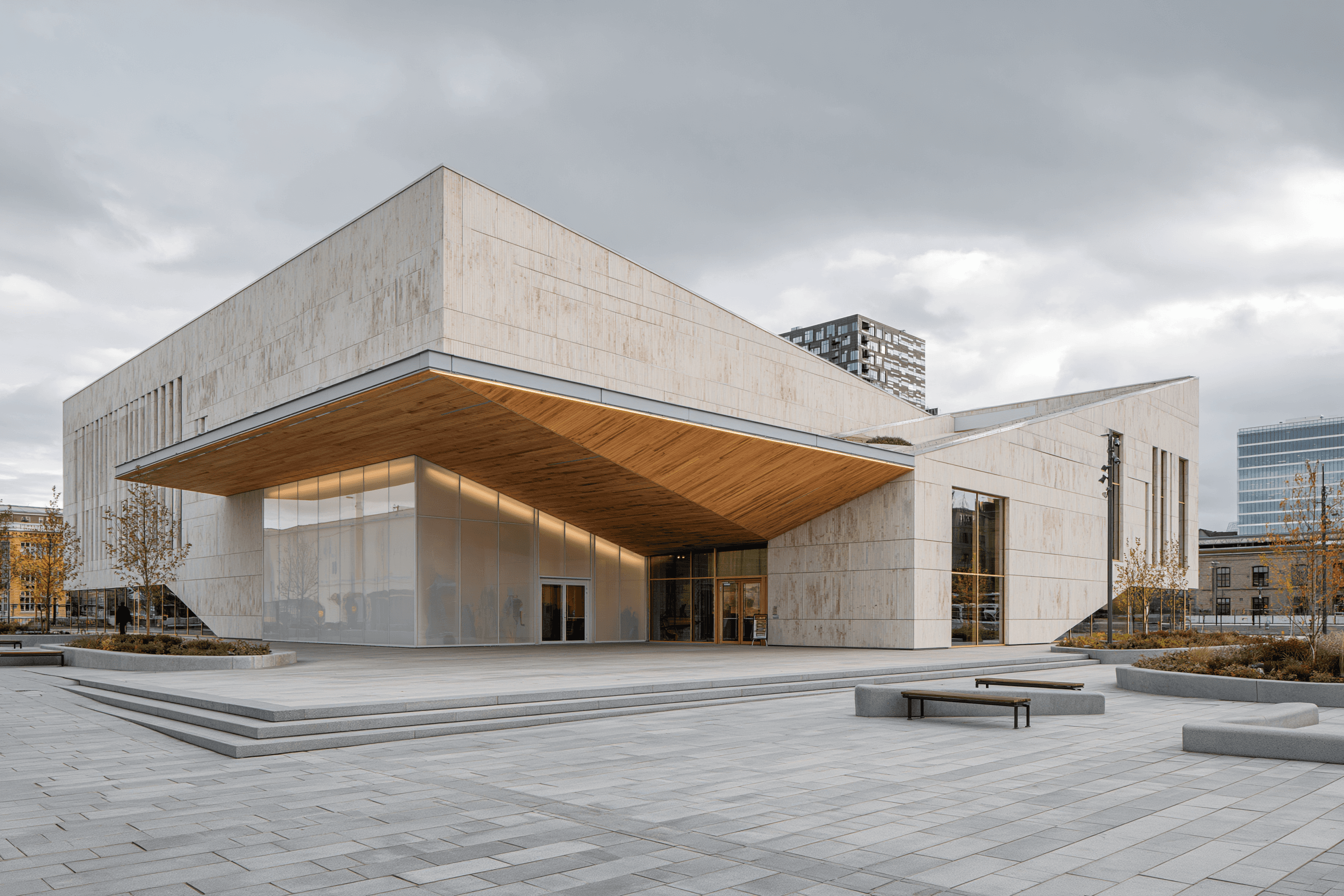
The primary material is in-situ concrete, formed with a pattern that references the timber construction traditions of the Norwegian coast. The board pattern is large — each plank impression is 300 millimetres wide — giving the surface a scale appropriate to the building's civic presence.
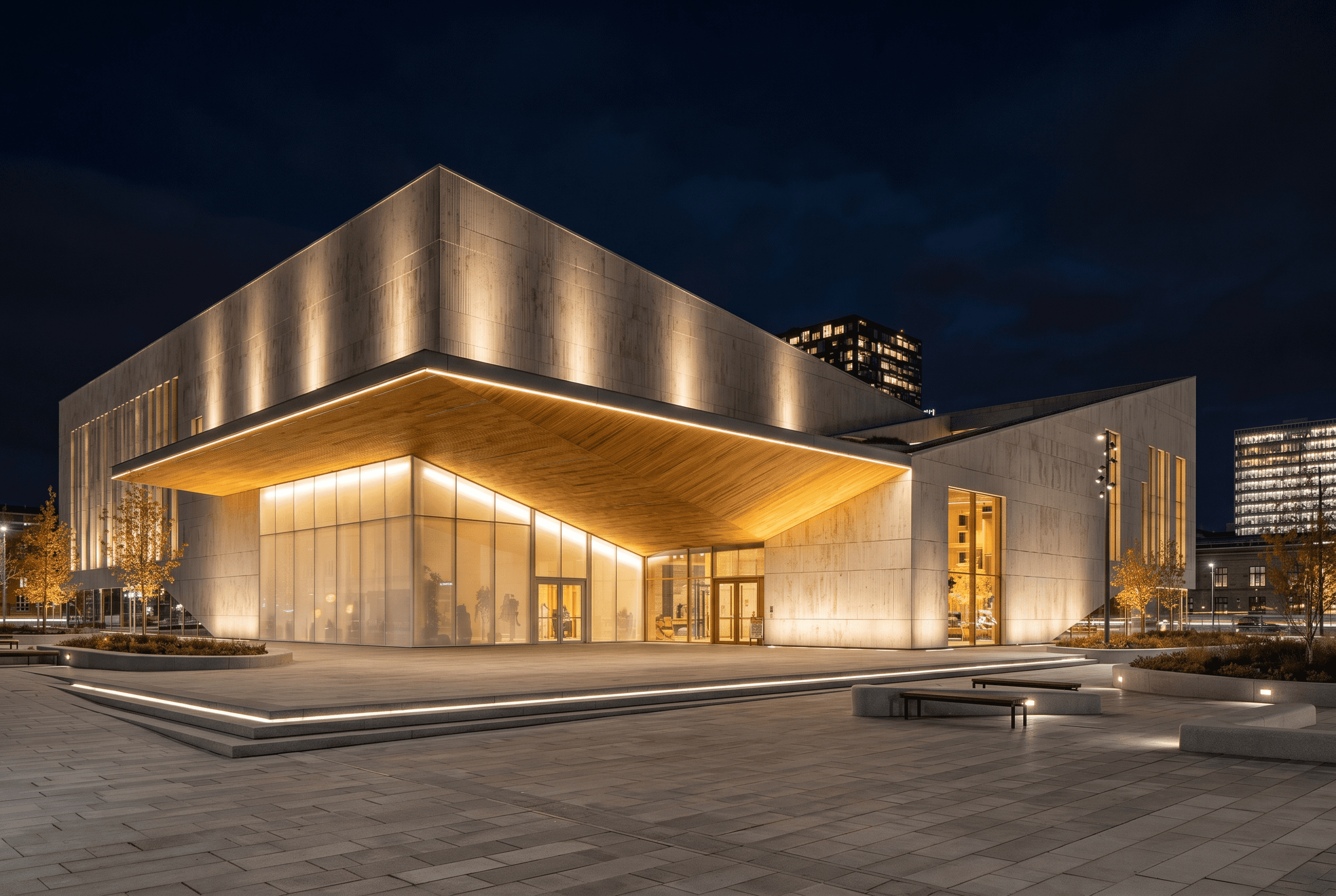
The curtain wall system uses triple-glazed units in dark-anodised aluminium frames. The glass has a slight warm tint — barely perceptible in daylight, visible at night when the interior light transforms the building into a luminous presence on the waterfront.
Cultural Programme
The building houses a 1,200-seat performance hall, a 400-seat flexible theatre, three gallery spaces totalling 2,400 square metres, a public library, a music school, and a restaurant with direct access to the waterfront terrace.
The programme was designed to support interdisciplinary practice: the gallery spaces can be darkened for performance; the theatre can be flooded with natural light for exhibition; the music school shares acoustic facilities with the performance hall. The boundaries between art forms are treated as opportunities rather than constraints.
Outcome
The Oslo Cultural Centre opened in March 2024. In its first six months of operation, it received 1.2 million visitors — a figure that exceeded all projections. More significantly, 60% of those visitors came without a ticket, simply to inhabit the public spaces. The building has become part of daily life in Oslo in a way that few civic buildings achieve. That was always the intention.
Overview
The Oslo Cultural Centre occupies a prominent waterfront site in the Bjørvika district, adjacent to the Oslo Opera House and directly facing the Oslofjord. The commission was awarded following an international competition in 2019, and construction completed in early 2024.
The brief asked for a building that would serve as a civic anchor for a neighbourhood in transformation: a place for performance, exhibition, gathering, and education that would be equally accessible to the city's oldest residents and its newest arrivals.
Design
The building is conceived as a threshold. Not a monument, not a landmark — a threshold between the city and the fjord, between the built and the open, between the programmed and the accidental.
The form is a single continuous horizontal volume that steps down toward the water in a series of cascading terraces. Each terrace is simultaneously roof, facade, and public space. The building cannot be read from a single viewpoint — it reveals itself differently from the street, from the water, and from above.
The primary structural move is a series of long-span concrete frames that allow the interior to be entirely column-free. The largest space — a 1,200-seat performance hall — is suspended within the building volume, isolated acoustically from the surrounding structure by a system of spring mounts. From outside, its presence is invisible. From inside, it is total.
Public Space
Forty percent of the building's area is publicly accessible without a ticket. The terraces, the foyer, the library, and the rooftop are open from six in the morning until midnight, every day of the year. This was a condition of the competition brief and a commitment that shaped every aspect of the design.
The foyer is not a lobby. It is a covered public square — a space with the scale and the ambition of the city outside, brought under a single roof. On a cold Oslo evening in January, it is the warmest place in the neighbourhood.
Materials
The primary material is in-situ concrete, formed with a pattern that references the timber construction traditions of the Norwegian coast. The board pattern is large — each plank impression is 300 millimetres wide — giving the surface a scale appropriate to the building's civic presence.
The curtain wall system uses triple-glazed units in dark-anodised aluminium frames. The glass has a slight warm tint — barely perceptible in daylight, visible at night when the interior light transforms the building into a luminous presence on the waterfront.
Cultural Programme
The building houses a 1,200-seat performance hall, a 400-seat flexible theatre, three gallery spaces totalling 2,400 square metres, a public library, a music school, and a restaurant with direct access to the waterfront terrace.
The programme was designed to support interdisciplinary practice: the gallery spaces can be darkened for performance; the theatre can be flooded with natural light for exhibition; the music school shares acoustic facilities with the performance hall. The boundaries between art forms are treated as opportunities rather than constraints.
Outcome
The Oslo Cultural Centre opened in March 2024. In its first six months of operation, it received 1.2 million visitors — a figure that exceeded all projections. More significantly, 60% of those visitors came without a ticket, simply to inhabit the public spaces. The building has become part of daily life in Oslo in a way that few civic buildings achieve. That was always the intention.
type
Cultural
Location
Oslo, NO
Year
2024